


Housing costs came up in nearly every one of the 36 governor's races in 2026. Now the winners have to turn those campaign promises into policy.
As of Nov. 16, all 36 races had been called. Most of the 36 winners, Democrats and Republicans alike, say the same thing: it takes too long and costs too much to build a home.
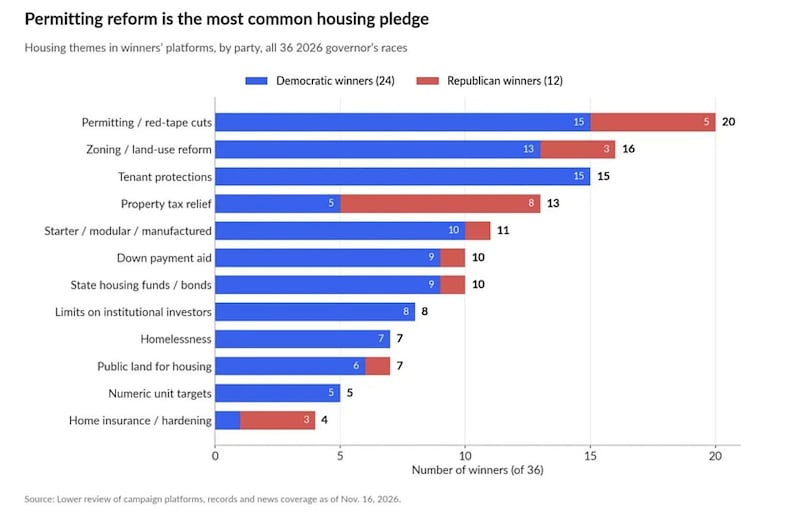
Their most common answer is faster permitting, which 20 of the 36 winners support. Zoning changes also appear in Democratic and Republican platforms alike.
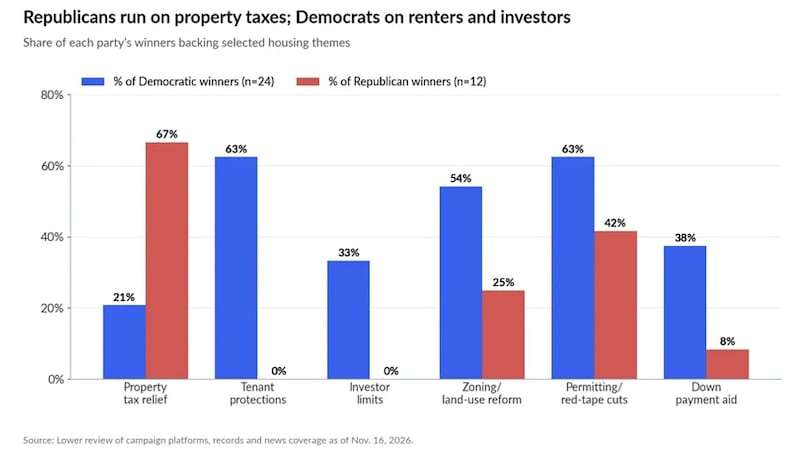
From there, the parties part ways. Many Democratic winners are targeting corporate landlords, rent-setting software, and large investors that buy homes. Many Republican winners are focused on lowering property taxes.
How Governors Plan to Increase Housing Affordability
Lower reviewed each winner's housing platform, track record, and recent statements.
Lower
Cutting Red Tape
Faster approvals are the nearest thing to common ground among this year’s winners: 20 of 36 back faster permitting, including 15 Democrats and five Republicans.
Several winners named deadlines. California Gov.-elect Xavier Becerra wants state reviews of housing projects to end in a final decision on a fixed schedule, and his plan offers 180 days as one example. New Mexico Gov.-elect Deb Haaland has called for a time limit on housing approvals. In Oregon, Gov. Tina Kotek's second-term agenda includes enforceable statewide permitting deadlines, part of the platform she rolled out in September.
Some incumbents can point to what they've already done. New Hampshire Gov. Kelly Ayotte signed a budget that gives state agencies 60 days to act on housing permits. Because that rule is already in place, it's part of her record rather than a new pledge.
Environmental review is also a target. New York Gov. Kathy Hochul's "Let Them Build" agenda proposed exempting some housing projects from the state's environmental review law, known as SEQRA. In Vermont, Gov. Phil Scott has urged lawmakers to ease development rules, with wetlands as his latest focus.
In Alaska, Gov.-elect Jonathan Kreiss-Tomkins wants a governor's housing task force, modeled on Atlanta's, to find land that can be developed and set up an expedited permitting system. He'd also make state land in and around cities and towns available for housing.
Republican winners tend to frame regulation as a cost that buyers end up paying. Tennessee Gov.-elect Marsha Blackburn said permitting and regulation account for 27.5% of what it costs to build a new home. Florida Gov.-elect Byron Donalds estimates permitting raises home construction costs by 20% to 30% and wants to shorten approval timelines.
Governors also disagree on how much pressure to put on local governments. Illinois Gov. JB Pritzker's BUILD plan would have legalized duplexes, triplexes, and accessory dwelling units on most residential lots statewide, but it stalled after pushback from local officials. Minnesota Gov.-elect Amy Klobuchar would rather reward communities that build more through a pro-housing incentive than force upzoning, though she acknowledged the state may eventually need to require more multifamily housing.
Some of the most consequential permitting changes are already on the books:
- Maryland: Under the Housing Certainty Act, which Gov. Wes Moore signed in May, local governments must evaluate a project under the rules in effect on the date its application was filed.
- Connecticut: HB 8002 allows housing to be built as of right in commercial and transit districts.
- Idaho: SB 1352, which Gov. Brad Little signed March 31, lowers minimum lot sizes for qualifying starter-home developments.
Republicans Target Property Tax Relief, Democrats Call for Tenant Protections
Lower
The widest gap between the parties is over who should get relief. Eight of the 12 Republican winners, or 67%, put property tax relief first. Among Democratic winners, 63% support tenant protections, while no Republican winner does.
Republican tax plans focus mostly on seniors:
- Alabama: Gov.-elect Tommy Tuberville's policy playbook opens with a plan to freeze property tax increases on seniors' homes.
- Oklahoma: Gov.-elect Mike Mazzei would end homestead property taxes for seniors and veterans.
- South Carolina: Gov.-elect Alan Wilson would automatically enroll eligible seniors in the homestead exemption.
- Tennessee: Blackburn said a tax cap for seniors has come up in discussions, and she described tax abatements for first-time buyers as one idea under consideration.
In Florida, Gov.-elect Byron Donalds plans to use a state tax commission to seek repeal of homestead property taxes. If full repeal proves unaffordable, he'd direct relief to seniors and working families instead. Arkansas has already acted: homeowners there now qualify for a $675 homestead tax credit, up from $600.
Several Democrats who flipped Republican-held governor’s offices offered similar relief:
- Georgia: Gov.-elect Keisha Lance Bottoms would turn the state's homeowner tax relief grant into an annual benefit, increase it from $18,000 to $25,000 of assessed value, and repeal the state's 2.25% tax on homeowners insurance premiums. Her campaign puts the typical homeowner's savings at roughly $885 a year.
- Ohio: Gov.-elect Amy Acton would lift the income cap for Ohio's homestead exemption from $41,000 to $50,000. She'd also send rebates of up to $1,000 to homeowners whose tax bills climb more than 4% in a year.
- Texas: Gov.-elect Gina Hinojosa has set a goal of eliminating residential property taxes.
- Kansas: Gov.-elect Cindy Holscher, whose win keeps the governor's office in Democratic hands, also made property taxes central to her campaign. She wants to lower the residential assessment rate from 11.5% to 9% and expand homestead exemptions for seniors and disabled veterans.
Protecting Renters From Algorithms and Fees
Four Democratic winners would ban algorithmic rent-setting tools: Weiser, Klobuchar, Ford, and Haaland. In Texas, Hinojosa has pledged to hold landlords accountable when they use AI pricing tools to overcharge renters.
Others want to lower renters' upfront costs. Shapiro would cap application fees and seal eviction records for tenants who weren't evicted. Ford would limit security deposits to one month's rent, down from the three months Nevada currently allows. Holscher sponsored a bill to cap late fees on rent, and she has also singled out rental application fees as a cost to address.
Rent control remains largely off the table. Healey opposed Massachusetts' rent control ballot question, and Ford's plan doesn't include it. Becerra is the exception, claiming he'd support California communities that adopt local rent control.
Banning Institutional Investors
Eight Democratic winners would put limits on institutional homebuyers. No Republican winner has proposed doing so. Their approaches differ:
- First-look windows: Michigan Gov.-elect Jocelyn Benson would keep private equity firms and large investors from buying a home during its first 100 days on the market.
- Purchase caps: Nevada Gov.-elect Aaron Ford wants to restrict Wall Street purchases of single-family homes. His plan doesn't name a number, though he has said a 100-unit cap would be a good starting point. In Texas, Hinojosa wrote a 2025 bill that would have barred institutional investors from buying more than 10 single-family homes during a state housing shortage.
- Disclosure: Becerra would require ownership disclosure for bulk home purchases and create public registries of institutional landlords.
Kreiss-Tomkins is focused on a different kind of outside owner. He wants to find ways to tax "dark homes," the second homes and vacation homes that nonresidents own in Alaska, so more of the market works for the state's own residents.
Mobile home parks are a related concern. Maine Gov.-elect Hannah Pingree has pledged to confront out-of-state private equity firms that buy the state's mobile home parks. Klobuchar wants to protect manufactured homeowners from unfair treatment by corporate owners, and Haaland's plan promises protections for people living in New Mexico's manufactured home communities.
These proposals would operate alongside federal law. Starting Jan. 7, 2027, the ROAD Act limits additional single-family home purchases by investors that control 350 or more of them. State caps and first-look windows could also apply to smaller investors that fall below the federal threshold.
What this means for buyers depends on where they live. In markets where big investors are active, first-look windows and caps could improve owner-occupants' odds on entry-level homes. Where those investors have a small footprint, the rules may change little. Vermont is one example: a state review of more than 20,000 home sales turned up little evidence of large-scale corporate buying.
Lower
Down Payment Assistance and Housing Funds
Several winners want to commit major sums to housing, though most of that money hasn’t been approved:
- Pennsylvania: Gov. Josh Shapiro's budget calls for a $1 billion critical infrastructure fund financed with general obligation bonds. Housing would receive most of the money, but the fund would also pay for energy projects and school buildings, and the legislature has to approve the borrowing.
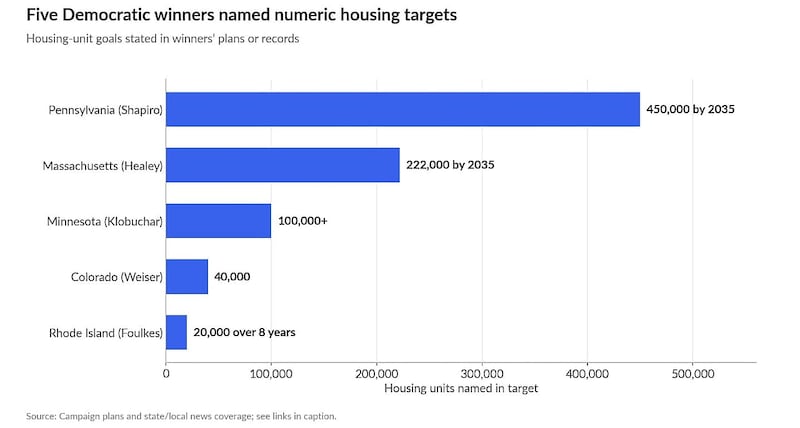
- Rhode Island: Gov.-elect Helena Foulkes' Rhode Home program would put revenue from the state's tax on millionaires into a revolving fund to build 20,000 units over eight years, with roughly $1 billion in total capacity. Whether voters get a say is up to the General Assembly.
- Maine: Pingree has pledged $100 million a year for building and preserving homes.
- New York: Hochul proposed $250 million to accelerate affordable housing and another $100 million for manufactured housing.
Ten winners promise down-payment aid, with some aimed at particular groups of buyers:
- Colorado: Gov.-elect Phil Weiser would widen down payment help for first-time buyers and essential workers, such as teachers, nurses, and first responders.
- Nevada: Ford would offer down payment aid through refundable tax credits for first-time buyers, teachers, first responders, military families, and veterans.
- Iowa: Gov.-elect Rob Sand wants first-time buyers to get interest-free down payment assistance. The state's current help is structured as a second mortgage that carries interest.
- Michigan: Benson has proposed tax credits to help with down payments.
Help with a down payment can make the upfront cost of a home more manageable, but it doesn’t create more housing. New programs also need funding and time to launch, so buyers in the market now should check what their state already offers.
Building Manufactured Homes
Factory-built housing shows up in 11 winners’ platforms as a way to add homes faster and for less money:
- New York: Hochul proposed $100 million to expand manufactured housing.
- Rhode Island: Foulkes wants incentives for modular construction and plans to attract manufacturers to the state.
- Maine: Pingree's plan would encourage modular, panelized, and other off-site methods, with a preference for products made in Maine.
- Minnesota and Colorado: Klobuchar has described modular homes as quicker and cheaper to build, and Weiser would back modular and prefab construction.
- Alaska: Kreiss-Tomkins wants to remove regulatory barriers to low-cost manufactured and modular homes, including trailers and tiny homes.
Federal policy is moving the same way, with a task force set up to expand factory-built housing.
Insurance Costs in the South
Several Southern winners linked affordability to homeowners insurance:
- Alabama: Tuberville would grow the Strengthen Alabama Homes fortified roof program, make sure insurers honor required discounts, and bring more insurers into the state, especially along the coast.
- Georgia: Bottoms would repeal the 2.25% tax on homeowners insurance premiums and require insurers to pass the savings on to customers.
- Florida: Donalds would pursue tort reform and expand home-hardening programs for properties built before 1992, the year Hurricane Andrew hit South Florida.
- South Carolina: Wilson wants the state Department of Insurance to use its existing authority to audit rate increases regularly and make the results public. His plan would also require quarterly updates to the governor's office and annual public reports on major carriers.
Because premiums also reflect disaster risk and rebuilding costs, state policy changes may not bring quick savings.
What to Watch in 2027
The first real test arrives in January, when most new governors are sworn in and legislatures convene. Here’s what to watch:
- Final results: Results stay unofficial until states certify them. Alaska plans to certify its results Nov. 25.
- Divided government: In Vermont, Scott will face a Democratic supermajority of 22 Senate seats and 112 House seats, enough to override his vetoes. In Illinois, Pritzker's BUILD plan has already stalled once. In Kansas, Holscher will work with Republican majorities in both chambers, but Democrats broke the GOP's veto-proof supermajority in the House, so her vetoes are more likely to stand.
- Ballot and constitutional routes: Donalds intends to pursue property tax repeal through Florida's Tax and Budget Reform Commission, which meets next year. Florida voters approved Amendment 3, which expands the homestead exemption, with about 62% of the vote, and Donalds still plans to seek full repeal through a state tax commission that meets next year. Rhode Island lawmakers would decide whether Foulkes' housing fund goes to voters.
- Day-one executive orders: Becerra has pledged to declare a housing state of emergency on his first day in office. Weiser plans to name a Chief Housing Officer and sign an executive order on day one.
- Federal action: Democrats will hold both chambers of Congress, but housing bills still face the filibuster and a possible presidential veto. The ROAD Act's restriction on large investors takes effect Jan. 7, 2027.
Methodology
Lower identified winners using MultiState's tracker, last updated Nov. 4, and checked them against AP race calls reported by local news outlets through Nov. 16, 2026. No results have been certified.
The housing summaries rely first on campaign websites, then on state and local news coverage. For incumbents without a new housing plan, we summarized their stated next-term priorities and their records. Policies already signed into law are labeled as law rather than proposals.
Theme tags reflect editorial judgment. A winner counts toward a theme only with a specific proposal or an enacted policy.
A full list of governors' policies can be found in the Lower study.
This story was produced by Lower and reviewed and distributed by Stacker.