


In recent years, artificial intelligence (AI) has evolved from a fringe tool into a mainstream resource for everyday investors. A 2026 survey of 1,000 U.S. adults conducted by SoFi highlights how widely AI is used for investing.
According to the survey, three out of four investors turn to AI for investing-related questions. Among investors using AI, 84% say they use AI tools weekly and 86% report they’ve made an investing decision based on AI-generated insights. These numbers paint a clear picture: AI is not merely a passive source of information — it is actively shaping investor behavior.
What follows is an in-depth look at how investors use these tools, how much they trust and verify AI information, and key factors driving (and slowing) adoption. Together, these insights provide insight into the potential for AI to reshape modern investing.
Key Findings From the AI Investing Survey
- Eighty-four percent of investors use AI tools at least weekly.
- Eighty-six percent of AI investors have made an investing decision based on AI-generated insights.
- Top five reasons for using AI include comparing investment options, researching stocks or companies, understanding risk, looking up investment terms and learning investing basics.
- Forty-six percent of investors use AI to ask questions they wouldn't feel comfortable asking others.
- While 80% of all investors surveyed trust AI at least somewhat, 26% report trusting it "a lot."
- Seventy-four percent of investors always or often verify AI investing information with other sources before acting.
How Often Are Investors Using AI Tools?
AI usage for investing appears to be moving beyond occasional experimentation into routine behavior, according to responses to SoFi's AI investing survey. Nearly five in six AI-using investors (84%) report using AI weekly. More specifically, 33% use AI daily, 41% use it a few times per week and 10% use it about once a week. This frequency suggests that AI tools are becoming habitual — more akin to checking market news or portfolio balances than conducting one-off research.
AI tools are broadly defined as environments that leverage advanced machine learning, often large language models (LLMs), to process and synthesize vast amounts of text and data.
Among investors who use AI, usage frequency varies by demographic. Investors ages 18–34, daily or near-daily use is common, while older investors tend to use AI tools less frequently.
When examining which AI tools are most popular among surveyed AI users, ChatGPT is the clear leader, used by 53% of respondents. Google Gemini follows at 28%, while Perplexity and Claude maintain smaller but notable user bases. Investors also report using AI tools integrated directly into brokerage platforms, highlighting the growth of embedded AI in financial services.

SoFi
Are Investors Acting on AI-Generated Information?
One of the most significant findings of the survey is the high proportion of investors acting on AI-generated information. Nearly 80% of AI users report asking for specific investment recommendations, according to SoFi’s survey, and an even larger share — 86% — have made a decision based on AI guidance.

SoFi
Other actions include starting to invest for the first time, adjusting portfolio allocations and deciding against a trade based on AI input.
That said, only about a quarter of investors who use AI reported trusting AI financial information “a lot,” as noted below, with many exercising caution when utilizing AI information for investing.
Made Investing Decision Based on AI Guidance
- Yes: 86%
- No: 12%
- Not sure: 2%
How Are Investors Using AI for Investing?
Investors surveyed are using AI for a wide range of purposes. According to survey findings, nearly half (just over 47%) of investors who use AI use it to compare investment options, while a similar percentage use it to research stocks or companies. This highlights AI's role as a research assistant capable of summarizing large amounts of information.
Risk evaluation is another key use case, with 45% using AI to assess risk and volatility. This suggests that investors may be relying on AI not just for identifying opportunities, but also for downside analysis. In addition, 44% use AI to learn investing terminology and 43% use it to learn investing concepts, underscoring its value as an educational tool.
Other common uses among this group include summarizing financial news, generating investment ideas and learning about taxes, retirement planning, and building a portfolio. Overall, AI may support the entire investing journey — from initial research to helping to inform decision-making.

SoFi
Why Do Some Investors Prefer AI Over Traditional Sources?
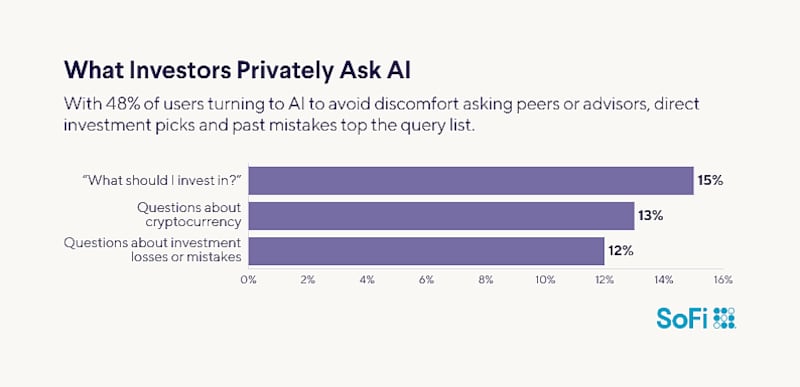
Beyond functionality, emotional and behavioral factors play a significant role in AI adoption. The SoFi AI investing survey found that nearly half of AI users (48%) say they turn to AI because they feel uncomfortable asking others financial questions. This highlights a powerful — and often overlooked — driver of AI use: the ability to seek information without fear of judgment.
Investing can be intimidating, especially for beginners. Asking questions — particularly basic ones — can feel uncomfortable in traditional settings such as with financial advisors or peers. AI offers a private, neutral environment.
SoFi
These findings suggest that, by lowering these psychological barriers to entry, AI may help democratize financial knowledge and empower new and hesitant investors.
Do Investors Trust AI for Financial Advice?
Trust in AI-generated financial information is present, but remains measured. While 80% of all investors surveyed trust AI at least somewhat, only about a quarter (26%) report trusting it “a lot.” This moderate trust level appears to reflect both the promise and the perceived limitations of current AI solutions.
Most respondents take a “trust but verify” approach. Nearly three-quarters (74%) of investors who use AI say they always or often verify AI-generated investing information with other sources before acting. Specifically:
- 30% always verify
- 44% often verify
This “trust but verify” approach reflects an understanding that AI may produce both valuable insights and potential inaccuracies.
What Concerns Do Investors Have About AI in Investing?
While adoption is widespread among the respondents surveyed, concerns about AI remain a significant factor limiting its full potential. The biggest worry is inaccurate or misleading information (cited by 42% of respondents), according to SoFi’s AI investing survey, followed by privacy and security risks (38%). In addition, 36% are unsure how to evaluate AI-generated content, revealing a knowledge gap that could hinder investors. These issues highlight the need for transparency, education and safeguards for AI investing tools.

SoFi
What Builds Trust in AI Investing Tools?
Understanding what drives trust is essential for continued adoption of AI. According to the survey, 42% of investors who use AI say they want sources or citations to support AI-generated information, reflecting a desire for transparency and verifiability.
Real-time market data is another key factor, cited by 42% of investors who use AI, indicating that they want information that is not only accurate but also up to date. Clear explanations of risks are also important, with 40% identifying this as a trust-building feature.
Additionally, among investors who do not currently use AI, nearly half (46%) say access to a human expert would increase their trust, pointing toward a strong interest in hybrid AI-human solutions.

SoFi
Can AI Expand Access to Investing Knowledge?
Looking ahead, AI has the potential to make investing more accessible. More than a third of respondents (36%) believe AI will make investing easier in the next two to three years. This aligns with the idea that AI may simplify complex processes and lower barriers to entry.
At the same time, another 36% of respondents say that while AI improves research, it still requires human input. Another 18% see AI making investing riskier due to misinformation. These viewpoints reflect a broader perspective: AI is a powerful tool, but not a complete replacement for human judgment.
What These Findings Suggest About the Future of AI Investing
The survey results suggest a shift in investor behavior. AI is no longer a novelty — it’s becoming embedded in everyday investing. Investors surveyed are using AI throughout the decision-making process, from generating ideas to providing research and analysis and determining potential risk.
Accessibility is another key theme. According to respondents, AI appears to be lowering barriers, particularly for newer investors, by providing a private, user-friendly way to explore financial topics. This could have long-term implications for who participates in investing and how they engage with it.
However, caution remains. Investors surveyed consistently cite the need for clear sources and citations, real-time market data and transparent explanations of risks. Most users continue to verify AI-generated information elsewhere and value human expertise for complex decisions.
The Takeaway: AI Is Becoming a Core Part of the Investor Toolkit
AI is reshaping the investing landscape by making information more accessible to new and experienced investors alike. According to SoFi’s survey, investors are not just experimenting with AI — they are integrating it into their routines and acting on its insights.
At the same time, a measured approach persists. Regular cross-checking, awareness of risks, and a demand for transparency show that investors are using AI carefully rather than blindly.
As adoption grows, AI may continue to play a role in investing by supporting research, informing decisions and expanding access to financial knowledge, while human judgment continues to guide the final call.
Methodology
These findings are based on self-reported data from an online survey of 1,000 U.S. adults (ages 18+) conducted Feb. 20, 2026. Due to rounding and multi-select questions, percentages may not total 100%.
This story was produced by SoFi and reviewed and distributed by Stacker.